
The coronavirus package provides a tidy format for the COVID-19 dataset collected by the Center for Systems Science and Engineering (CSSE) at Johns Hopkins University. The dataset includes daily new and death cases between January 2020 and March 2023 and recovery cases until August 2022.
More details available here, and a csv format of the package dataset available here
Data source: https://github.com/CSSEGISandData/COVID-19

Important Notes
- As of March 10th, 2023, JHU CCSE stopped collecting and tracking new cases
- As of August 4th, 2022 JHU CCSE stopped track recovery cases, please see this issue for more details
- Negative values and/or anomalies may occurred in the data for the following reasons:
- The calculation of the daily cases from the raw data which is in cumulative format is done by taking the daily difference. In some cases, some retro updates not tie to the day that they actually occurred such as removing false positive cases
- Anomalies or error in the raw data
- Please see this issue for more details
Installation
Install the CRAN version:
install.packages("coronavirus")Install the Github version (refreshed on a daily bases):
# install.packages("devtools")
devtools::install_github("RamiKrispin/coronavirus")
Datasets
The package provides the following two datasets:
-
coronavirus - tidy (long) format of the JHU CCSE datasets. That includes the following columns:
-
date- The date of the observation, usingDateclass -
province- Name of province/state, for countries where data is provided split across multiple provinces/states -
country- Name of country/region -
lat- The latitude code -
long- The longitude code -
type- An indicator for the type of cases (confirmed, death, recovered) -
cases- Number of cases on given date -
uid- Country code -
province_state- Province or state if applicable -
iso2- Officially assigned country code identifiers with two-letter -
iso3- Officially assigned country code identifiers with three-letter -
code3- UN country code -
fips- Federal Information Processing Standards code that uniquely identifies counties within the USA -
combined_key- Country and province (if applicable) -
population- Country or province population -
continent_name- Continent name -
continent_code- Continent code
-
-
covid19_vaccine - a tidy (long) format of the the Johns Hopkins Centers for Civic Impact global vaccination dataset by country. This dataset includes the following columns:
-
country_region- Country or region name -
date- Data collection date in YYYY-MM-DD format -
doses_admin- Cumulative number of doses administered. When a vaccine requires multiple doses, each one is counted independently -
people_partially_vaccinated- Cumulative number of people who received at least one vaccine dose. When the person receives a prescribed second dose, it is not counted twice -
people_fully_vaccinated- Cumulative number of people who received all prescribed doses necessary to be considered fully vaccinated -
report_date_string- Data report date in YYYY-MM-DD format -
uid- Country code -
province_state- Province or state if applicable -
iso2- Officially assigned country code identifiers with two-letter -
iso3- Officially assigned country code identifiers with three-letter -
code3- UN country code -
fips- Federal Information Processing Standards code that uniquely identifies counties within the USA -
lat- Latitude -
long- Longitude -
combined_key- Country and province (if applicable) -
population- Country or province population -
continent_name- Continent name -
continent_code- Continent code
-
The refresh_coronavirus_jhu function enables to load of the data directly from the package repository using the Covid19R project data standard format:
covid19_df <- refresh_coronavirus_jhu()
#> [4;32mLoading 2020 data[0m
#> [4;32mLoading 2021 data[0m
#> [4;32mLoading 2022 data[0m
#> [4;32mLoading 2023 data[0m

head(covid19_df)
#>         date    location location_type location_code location_code_type
#> 1 2021-12-31 Afghanistan       country            AF         iso_3166_2
#> 2 2020-03-24 Afghanistan       country            AF         iso_3166_2
#> 3 2022-11-02 Afghanistan       country            AF         iso_3166_2
#> 4 2020-03-23 Afghanistan       country            AF         iso_3166_2
#> 5 2021-08-09 Afghanistan       country            AF         iso_3166_2
#> 6 2023-03-02 Afghanistan       country            AF         iso_3166_2
#>       data_type value      lat     long
#> 1     cases_new    28 33.93911 67.70995
#> 2 recovered_new     0 33.93911 67.70995
#> 3     cases_new    98 33.93911 67.70995
#> 4 recovered_new     0 33.93911 67.70995
#> 5    deaths_new    28 33.93911 67.70995
#> 6     cases_new    18 33.93911 67.70995
Usage
data("coronavirus")

head(coronavirus)
#>         date province country     lat      long      type cases   uid iso2 iso3
#> 1 2020-01-22  Alberta  Canada 53.9333 -116.5765 confirmed     0 12401   CA  CAN
#> 2 2020-01-23  Alberta  Canada 53.9333 -116.5765 confirmed     0 12401   CA  CAN
#> 3 2020-01-24  Alberta  Canada 53.9333 -116.5765 confirmed     0 12401   CA  CAN
#> 4 2020-01-25  Alberta  Canada 53.9333 -116.5765 confirmed     0 12401   CA  CAN
#> 5 2020-01-26  Alberta  Canada 53.9333 -116.5765 confirmed     0 12401   CA  CAN
#> 6 2020-01-27  Alberta  Canada 53.9333 -116.5765 confirmed     0 12401   CA  CAN
#>   code3    combined_key population continent_name continent_code
#> 1   124 Alberta, Canada    4413146  North America             NA
#> 2   124 Alberta, Canada    4413146  North America             NA
#> 3   124 Alberta, Canada    4413146  North America             NA
#> 4   124 Alberta, Canada    4413146  North America             NA
#> 5   124 Alberta, Canada    4413146  North America             NA
#> 6   124 Alberta, Canada    4413146  North America             NA
Summary of the total confrimed cases by country (top 20):
library(dplyr)

summary_df <- coronavirus %>%
  filter(type == "confirmed") %>%
  group_by(country) %>%
  summarise(total_cases = sum(cases)) %>%
  arrange(-total_cases)

summary_df %>% head(20)
#> # A tibble: 20 × 2
#>    country        total_cases
#>    <chr>                <dbl>
#>  1 US               103802702
#>  2 India             44690738
#>  3 France            39866718
#>  4 Germany           38249060
#>  5 Brazil            37076053
#>  6 Japan             33320438
#>  7 Korea, South      30615522
#>  8 Italy             25603510
#>  9 United Kingdom    24658705
#> 10 Russia            22075858
#> 11 Turkey            17042722
#> 12 Spain             13770429
#> 13 Vietnam           11526994
#> 14 Australia         11399460
#> 15 Argentina         10044957
#> 16 Taiwan*            9970937
#> 17 Netherlands        8712835
#> 18 Iran               7572311
#> 19 Mexico             7483444
#> 20 Indonesia          6738225
Summary of new cases during the past 24 hours by country and type (as of 2023-03-09):
library(tidyr)

coronavirus %>%
  filter(date == max(date)) %>%
  select(country, type, cases) %>%
  group_by(country, type) %>%
  summarise(total_cases = sum(cases)) %>%
  pivot_wider(names_from = type,
              values_from = total_cases) %>%
  arrange(-confirmed)
#> # A tibble: 201 × 4
#> # Groups:   country [201]
#>    country        confirmed death recovery
#>    <chr>              <dbl> <dbl>    <dbl>
#>  1 US                 46931   590        0
#>  2 United Kingdom     28783     0        0
#>  3 Australia          13926   115        0
#>  4 Russia             12385    38        0
#>  5 Belgium            11570    39        0
#>  6 Korea, South       10335    12        0
#>  7 Japan               9834    80        0
#>  8 Germany             7829   127        0
#>  9 France              6308    11        0
#> 10 Austria             5283    21        0
#> # … with 191 more rows
Plotting daily confirmed and death cases in Brazil:
library(plotly)

coronavirus %>%
  group_by(type, date) %>%
  summarise(total_cases = sum(cases)) %>%
  pivot_wider(names_from = type, values_from = total_cases) %>%
  arrange(date) %>%
  mutate(active = confirmed - death - recovery) %>%
  mutate(active_total = cumsum(active),
                recovered_total = cumsum(recovery),
                death_total = cumsum(death)) %>%
  plot_ly(x = ~ date,
                  y = ~ active_total,
                  name = 'Active',
                  fillcolor = '#1f77b4',
                  type = 'scatter',
                  mode = 'none',
                  stackgroup = 'one') %>%
  add_trace(y = ~ death_total,
             name = "Death",
             fillcolor = '#E41317') %>%
  add_trace(y = ~recovered_total,
            name = 'Recovered',
            fillcolor = 'forestgreen') %>%
  layout(title = "Distribution of Covid19 Cases Worldwide",
         legend = list(x = 0.1, y = 0.9),
         yaxis = list(title = "Number of Cases"),
         xaxis = list(title = "Source: Johns Hopkins University Center for Systems Science and Engineering"))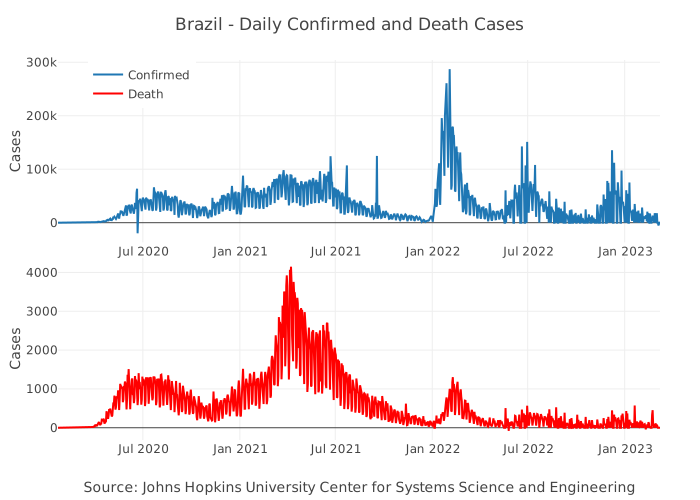
Plot the confirmed cases distribution by counrty with treemap plot:
conf_df <- coronavirus %>%
  filter(type == "confirmed") %>%
  group_by(country) %>%
  summarise(total_cases = sum(cases)) %>%
  arrange(-total_cases) %>%
  mutate(parents = "Confirmed") %>%
  ungroup()

  plot_ly(data = conf_df,
          type= "treemap",
          values = ~total_cases,
          labels= ~ country,
          parents=  ~parents,
          domain = list(column=0),
          name = "Confirmed",
          textinfo="label+value+percent parent")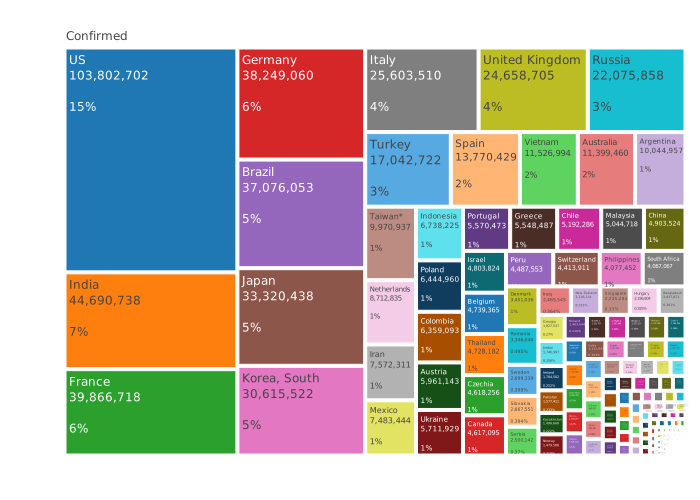
data(covid19_vaccine)

head(covid19_vaccine)
#>         date country_region continent_name continent_code combined_key
#> 1 2020-12-29        Austria         Europe             EU      Austria
#> 2 2020-12-29        Bahrain           Asia             AS      Bahrain
#> 3 2020-12-29        Belarus         Europe             EU      Belarus
#> 4 2020-12-29        Belgium         Europe             EU      Belgium
#> 5 2020-12-29         Canada  North America             NA       Canada
#> 6 2020-12-29          Chile  South America             SA        Chile
#>   doses_admin people_at_least_one_dose population uid iso2 iso3 code3 fips
#> 1        2123                     2123    9006400  40   AT  AUT    40 <NA>
#> 2       55014                    55014    1701583  48   BH  BHR    48 <NA>
#> 3           0                        0    9449321 112   BY  BLR   112 <NA>
#> 4         340                      340   11589616  56   BE  BEL    56 <NA>
#> 5       59079                    59078   37855702 124   CA  CAN   124 <NA>
#> 6          NA                       NA   19116209 152   CL  CHL   152 <NA>
#>        lat       long
#> 1  47.5162  14.550100
#> 2  26.0275  50.550000
#> 3  53.7098  27.953400
#> 4  50.8333   4.469936
#> 5  60.0000 -95.000000
#> 6 -35.6751 -71.543000
Taking a snapshot of the data from the most recent date available and calculate the ratio between total doses admin and the population size:
df_summary <- covid19_vaccine |>
  filter(date == max(date)) |>
  select(date, country_region, doses_admin, total = people_at_least_one_dose, population, continent_name) |>
  mutate(doses_pop_ratio = doses_admin / population,
         total_pop_ratio = total / population) |>
  filter(country_region != "World",
         !is.na(population),
         !is.na(total)) |>
  arrange(- total)

head(df_summary, 10)
#>          date country_region doses_admin      total population continent_name
#> 1  2023-03-09          China          NA 1310292000 1404676330           Asia
#> 2  2023-03-09          India          NA 1027379945 1380004385           Asia
#> 3  2023-03-09             US   672076105  269554116  329466283  North America
#> 4  2023-03-09      Indonesia   444303130  203657535  273523621           Asia
#> 5  2023-03-09         Brazil   502262440  189395212  212559409  South America
#> 6  2023-03-09       Pakistan   333759565  162219717  220892331           Asia
#> 7  2023-03-09     Bangladesh   355143411  151190373  164689383           Asia
#> 8  2023-03-09          Japan   382415648  104675948  126476458           Asia
#> 9  2023-03-09         Mexico   225063079   99071001  127792286  North America
#> 10 2023-03-09        Vietnam   266252632   90466947   97338583           Asia
#>    doses_pop_ratio total_pop_ratio
#> 1               NA       0.9328071
#> 2               NA       0.7444759
#> 3         2.039893       0.8181539
#> 4         1.624368       0.7445702
#> 5         2.362927       0.8910225
#> 6         1.510960       0.7343837
#> 7         2.156444       0.9180335
#> 8         3.023611       0.8276319
#> 9         1.761163       0.7752502
#> 10        2.735325       0.9294048
Plot of the total doses and population ratio by country:
# Setting the diagonal lines range
line_start <- 10000
line_end <- 1500 * 10 ^ 6

# Filter the data
d <- df_summary |>
  filter(country_region != "World",
         !is.na(population),
         !is.na(total))


# Replot it
p3 <- plot_ly() |>
  add_markers(x = d$population,
              y = d$total,
              text = ~ paste("Country: ", d$country_region, "<br>",
                             "Population: ", d$population, "<br>",
                             "Total Doses: ", d$total, "<br>",
                             "Ratio: ", round(d$total_pop_ratio, 2),
                             sep = ""),
              color = d$continent_name,
              type = "scatter",
              mode = "markers") |>
  add_lines(x = c(line_start, line_end),
            y = c(line_start, line_end),
            showlegend = FALSE,
            line = list(color = "gray", width = 0.5)) |>
  add_lines(x = c(line_start, line_end),
            y = c(0.5 * line_start, 0.5 * line_end),
            showlegend = FALSE,
            line = list(color = "gray", width = 0.5)) |>

  add_lines(x = c(line_start, line_end),
            y = c(0.25 * line_start, 0.25 * line_end),
            showlegend = FALSE,
            line = list(color = "gray", width = 0.5)) |>
  add_annotations(text = "1:1",
                  x = log10(line_end * 1.25),
                  y = log10(line_end * 1.25),
                  showarrow = FALSE,
                  textangle = -25,
                  font = list(size = 8),
                  xref = "x",
                  yref = "y") |>
  add_annotations(text = "1:2",
                  x = log10(line_end * 1.25),
                  y = log10(0.5 * line_end * 1.25),
                  showarrow = FALSE,
                  textangle = -25,
                  font = list(size = 8),
                  xref = "x",
                  yref = "y") |>
  add_annotations(text = "1:4",
                  x = log10(line_end * 1.25),
                  y = log10(0.25 * line_end * 1.25),
                  showarrow = FALSE,
                  textangle = -25,
                  font = list(size = 8),
                  xref = "x",
                  yref = "y") |>
  add_annotations(text = "Source: Johns Hopkins University - Centers for Civic Impact",
                  showarrow = FALSE,
                  xref = "paper",
                  yref = "paper",
                  x = -0.05, y = - 0.33) |>
  layout(title = "Covid19 Vaccine - Total Doses vs. Population Ratio (Log Scale)",
         margin = list(l = 50, r = 50, b = 90, t = 70),
         yaxis = list(title = "Number of Doses",
                      type = "log"),
         xaxis = list(title = "Population Size",
                      type = "log"),
         legend = list(x = 0.75, y = 0.05))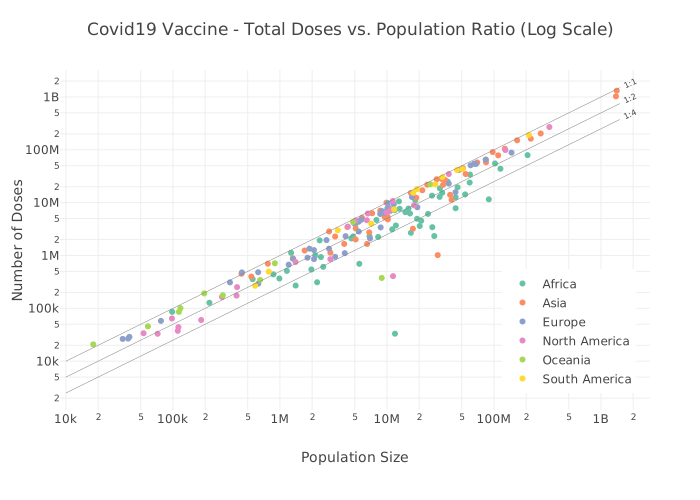
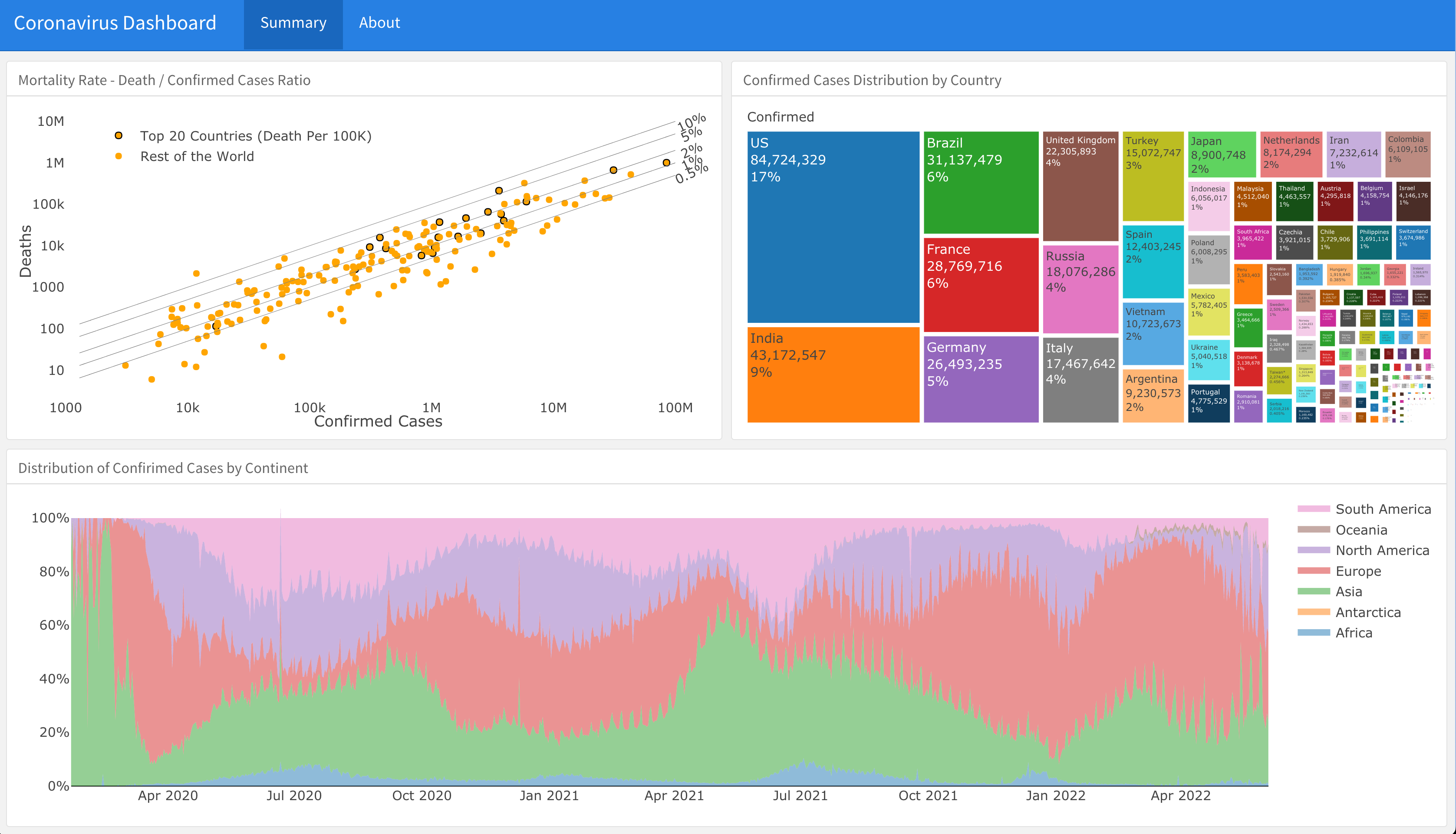
Dashboard
Note: Currently, the dashboard is under maintenance due to recent changes in the data structure. Please see this issue
A supporting dashboard is available here
Data Sources
The raw data pulled and arranged by the Johns Hopkins University Center for Systems Science and Engineering (JHU CCSE) from the following resources:
- World Health Organization (WHO): https://www.who.int/
- DXY.cn. Pneumonia. 2020. https://ncov.dxy.cn/ncovh5/view/pneumonia.
- BNO News: https://bnonews.com/index.php/2020/04/the-latest-coronavirus-cases/
- National Health Commission of the People’s Republic of China (NHC):
http:://www.nhc.gov.cn/xcs/yqtb/list_gzbd.shtml
- China CDC (CCDC): http:://weekly.chinacdc.cn/news/TrackingtheEpidemic.htm
- Hong Kong Department of Health: https://www.chp.gov.hk/en/features/102465.html
- Macau Government: https://www.ssm.gov.mo/portal/
- Taiwan CDC: https://sites.google.com/cdc.gov.tw/2019ncov/taiwan?authuser=0
- US CDC: https://www.cdc.gov/coronavirus/2019-ncov/index.html
- Government of Canada: https://www.canada.ca/en/public-health/services/diseases/2019-novel-coronavirus-infection/symptoms.html
- Australia Government Department of Health:https://www.health.gov.au/health-alerts/covid-19
- European Centre for Disease Prevention and Control (ECDC): https://www.ecdc.europa.eu/en/covid-19/country-overviews
- Ministry of Health Singapore (MOH): https://www.moh.gov.sg/covid-19
- Italy Ministry of Health: https://www.salute.gov.it/nuovocoronavirus
- 1Point3Arces: https://coronavirus.1point3acres.com/en
- WorldoMeters: https://www.worldometers.info/coronavirus/
- COVID Tracking Project: https://covidtracking.com/data/. (US Testing and Hospitalization Data. We use the maximum reported value from “Currently” and “Cumulative” Hospitalized for our hospitalization number reported for each state.)
- French Government: https://dashboard.covid19.data.gouv.fr/
- COVID Live (Australia): https://covidlive.com.au/
- Washington State Department of Health:https://doh.wa.gov/emergencies/covid-19
- Maryland Department of Health: https://coronavirus.maryland.gov/
- New York State Department of Health: https://health.data.ny.gov/Health/New-York-State-Statewide-COVID-19-Testing/xdss-u53e/data
- NYC Department of Health and Mental Hygiene: https://www.nyc.gov/site/doh/covid/covid-19-data.page and https://github.com/nychealth/coronavirus-data
- Florida Department of Health Dashboard: https://services1.arcgis.com/CY1LXxl9zlJeBuRZ/arcgis/rest/services/Florida_COVID19_Cases/FeatureServer/0 and https://fdoh.maps.arcgis.com/apps/dashboards/index.html#/8d0de33f260d444c852a615dc7837c86
- Palestine (West Bank and Gaza): https://corona.ps/details
- Israel: https://govextra.gov.il/ministry-of-health/corona/corona-virus/
- Colorado: https://covid19.colorado.gov/




